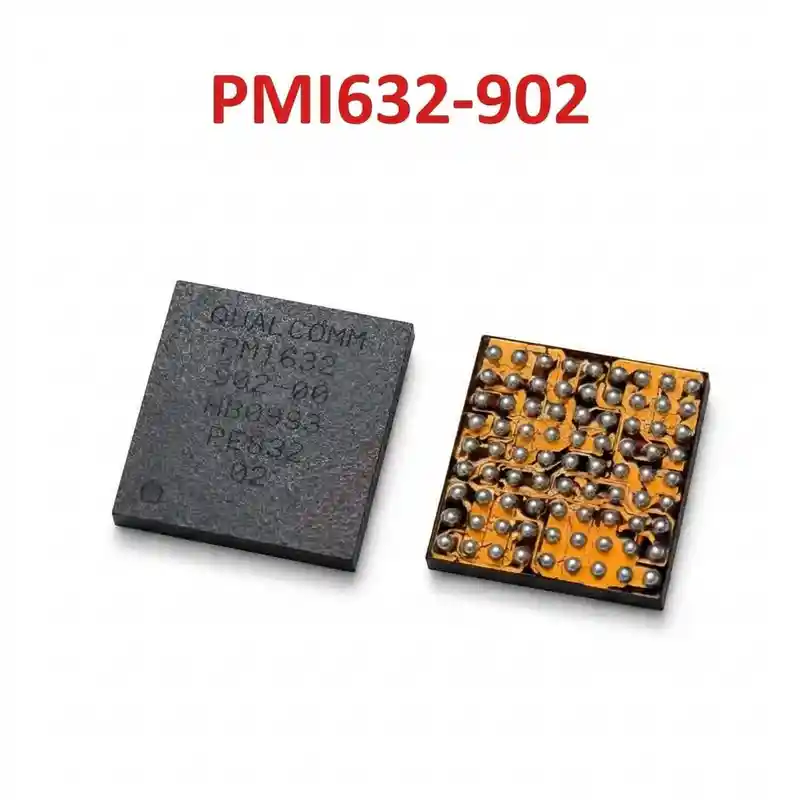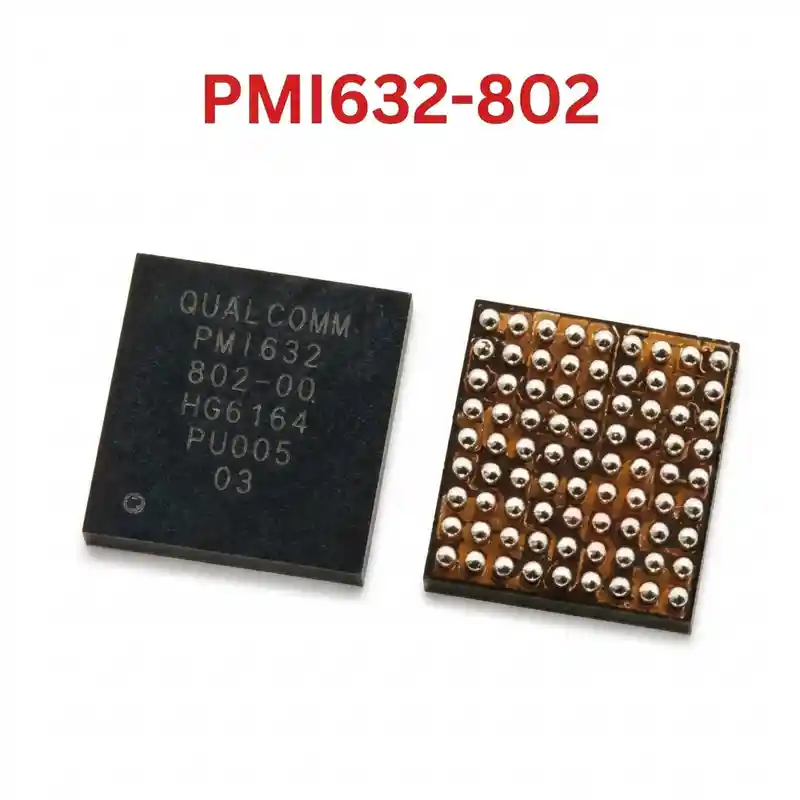

PM8110 IC
As low as
Rs 280.00
Worldwide shipping · Cash on Delivery
Product Details
====================================================================================================
QUALCOMM PM8110 (PM-8110-0-118WLNSP) MASTER PMIC REPAIR & REWORK GUIDE
====================================================================================================
1. PRODUCT IDENTIFICATION & SILICON SPECIFICATIONS:
----------------------------------------------------------------------------------------------------
- Silicon Laser Marking: PM8110 (Common Silkscreen Marking: PM8110 0VV)
- Full Manufacturer Part Number: PM-8110-0-118WLNSP-HR-03-0
- Silicon Manufacturer: Qualcomm Technologies, Inc.
- Package Form Factor: 118-Ball Wafer-Level Nano-Scale Package (118 WLNSP / BGA)
- Functional Classification: Primary All-in-One Master Power Management IC (Power Supervisor)
- Primary Target SoC Platforms: Qualcomm Snapdragon 200 (MSM8210, MSM8610, MSM8212, MSM8612)
- Regulated Output Domains:
* Synchronous Step-Down Buck Converters:
- VDD_APC: CPU Core Supply (~1.05V – 1.25V Dynamic Voltage Scaling for Cortex-A7 cores).
- VDD_MEM: LPDDR2 / LPDDR3 SDRAM Memory Supply (1.2V / 1.8V).
* Linear Low-Dropout (LDO) Regulators:
- VREG_EMMC / NAND: 2.85V VDD flash supply and 1.8V VIO peripheral supply.
- Baseband & RF Transceiver clean LDO rails (1.2V, 1.8V, 2.8V).
- Display LCD Bias & Touchscreen I2C lines (2.8V – 3.0V).
- Camera Sensor rails: 2.8V AVDD and 1.2V DVDD.
* System Clock & Power Control:
- Integrated 32.768kHz sleep crystal oscillator driver.
- Hardware debounce circuit for Power Key (KYPD_PWR_N).
- System reset supervisor monitoring PS_HOLD from MSM8210.
* Battery Charging Subsystem:
- Internal linear/switch charger converting USB VBUS (5.0V) to regulated VBAT (4.2V – 4.35V).
2. COMPATIBLE SMARTPHONE LOGIC BOARDS:
----------------------------------------------------------------------------------------------------
- Huawei:
* Ascend Y625 (Y625-U32, Y625-U21)
* Ascend Y530 (Y530-U00)
* Ascend G6 3G (G6-U00, G6-U10)
* Ascend G630
* MediaPad 7 Youth 2 (S7-721G, S7-721u Tablet)
- Samsung:
* Galaxy Trend 3 (SM-G3502, SM-G3508)
* Galaxy Core CDMA / Style (SCH-I679, GT-I679)
- HTC:
* Desire 516 Dual SIM
- Alcatel:
* One Touch Pop 7 / Fierce 2 (7040N)
3. TYPICAL BOARD-LEVEL FAULT SYMPTOMS:
----------------------------------------------------------------------------------------------------
- Handset Completely Dead (0.00A or Stuck Low Current Draw ~0.03A – 0.06A):
* Pressing power button draws a fixed 30mA – 60mA on DC power supply and hangs permanently.
* Cause: Missing CPU core buck voltage (VDD_APC) or defective 32.768kHz sleep crystal preventing the
MSM processor from exiting low-power reset.
- Fake Charging / Zero USB Current Draw (0.00A):
* Handset shows charging animation on the LCD, but draws 0.00A on a USB current tester; battery percentage
remains stuck or slowly discharges due to an open/burnt internal charging FET inside PM8110.
- Full Motherboard Short Circuit (VBAT or VPH_PWR Short to Ground):
* Internal breakdown of PM8110's high-side power MOSFET pulls the battery positive rail to ground
(0.000V in diode mode), causing the bench power supply to trip overcurrent protection instantly.
- Constant Rebooting / Bootloop on Huawei / Samsung Logo:
* Phone powers on, displays boot logo for 2–3 seconds, and restarts continuously due to voltage droop
on the CPU APC core coil under load.
4. STEP-BY-STEP MULTIMETER TESTING & DIAGNOSTICS:
----------------------------------------------------------------------------------------------------
A. Cold Testing (Diode Mode Check - Board Powered Off):
1. Place Multimeter in Diode Mode. Connect RED probe to motherboard GND shield:
- Battery Positive Connector Pin (VBAT): Normal ~450mV – 550mV.
- VREG_APC CPU Core Inductor: Normal ~110mV – 210mV (must NOT read 0.000V).
- VREG_MEM Memory Inductor: Normal ~320mV – 440mV.
- Power Key Pin (KYPD_PWR_N): Normal ~600mV – 750mV.
- USB VBUS 5V Pin: Normal ~500mV – 650mV.
2. Short-Circuit Isolation:
- If VBAT reads 0.000V, inject 3.8V DC (limited to 2.0A) onto VBAT using rosin smoke or a thermal camera.
If PM8110 heats up immediately, remove the IC to clear the short.
B. Live Operating Voltage Check (Hot Testing):
1. Connect DC power supply at 3.9V to battery terminals.
2. Verify Power Key pin measures steady ~1.8V to 3.0V DC.
3. Press Power Key and measure output rails:
- CPU Core inductor (VDD_APC) must rise to 1.15V – 1.20V DC.
- Memory rail (VDD_MEM) must read steady 1.2V DC.
- 32.768kHz crystal pins must output clean clock oscillation.
4. If Power Key drops to 0V upon pressing but all buck inductors show 0.0V, inspect RTC crystal, then replace PM8110.
5. SOLDERING, REBALLING & REWORK SPECIFICATIONS:
----------------------------------------------------------------------------------------------------
- Thermal Shielding:
* Mask the adjacent MSM8210 / MSM8610 processor and eMMC storage chip with multi-layer Kapton tape
and thick copper heatsink foil to prevent collateral solder ball bridging under neighboring chips.
- IC Removal:
* Apply non-corrosive RMA tacky BGA flux around PM8110.
* Hot air station settings: 310°C – 320°C with 40% – 50% airflow.
* Move nozzle in uniform circular paths. As soon as all solder balls liquefy, lift the IC vertically
with fine micro-tweezers. Never pry or force against cold solder.
- Pad Preparation & Cleaning:
* Remove residual lead-free solder using copper desoldering braid and an iron tip set to 290°C – 300°C.
* Clean thoroughly with 99% Isopropyl Alcohol (IPA) and verify under microscope for any lifted pads.
- Reballing Procedure:
* Use a dedicated 0.12mm stencil compatible with Qualcomm PM8110 (118 balls).
* Apply 183°C (Sn63/Pb37) leaded solder paste evenly. Heat gently at 290°C until all balls form uniform spheres.
- Re-installation:
* Apply a microscope-thin film of flux to motherboard pads.
* Align Pin 1 dot with the PCB corner indicator. Reflow at 305°C – 315°C until the IC naturally self-centers.
* Let the board cool naturally for 5 minutes before applying DC power.
====================================================================================================
You may also like