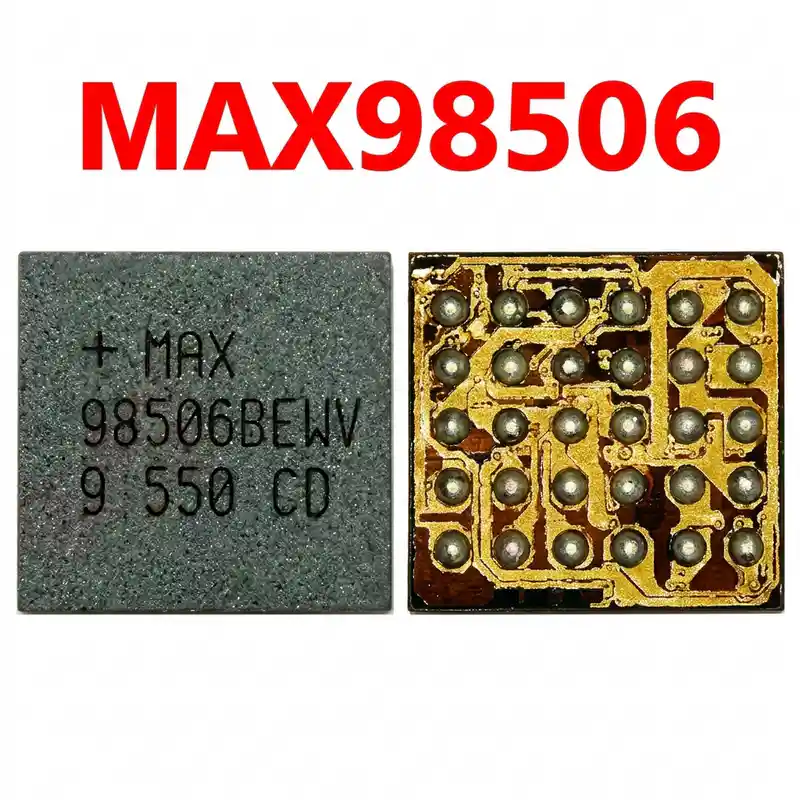

MAX77932B IC
As low as
Rs 0.00
Worldwide shipping · Cash on Delivery
Product Details
--------------------------------------------------------------------------------
SECTION 1: ELECTRICAL TOPOLOGY & SWITCHED-CAPACITOR ARCHITECTURE
--------------------------------------------------------------------------------
1. Two-Phase Flying Capacitor Operation:
- High-voltage Input (VIN): Directly supplied by 2S battery pack (+7.6V to +8.8V DC nominal).
- Phase 1 & Phase 2 Switching Nodes: Uses external ceramic flying capacitors (CFLY1 and CFLY2, typically 10µF - 22µF low-ESR ceramic caps) to transfer charge without magnetic energy storage (inductors).
- Regulated Divided Output (VOUT): Outputs exactly VIN / 2 (+3.8V to +4.4V DC) onto system power rail (VPH_PWR / VSYS).
- I2C Control Interface: Serial communication bus with Host AP for adjusting soft-start ramp rate, clock frequency, and reading fault diagnostic registers.
--------------------------------------------------------------------------------
SECTION 2: STEP-BY-STEP MULTIMETER TESTING & DIAGNOSTICS
--------------------------------------------------------------------------------
1. Cold Resistance Testing (Diode Mode Readings - RED probe to GND, BLACK probe on test points):
- 2S Battery Input (VIN Capacitors near battery connector):
* Normal Reading: ~450 mV to 580 mV (Reverse mode must read OL / Infinite).
* Short Circuit Fault: 0.000V indicates blown high-side switching FET.
- VOUT / System Output Capacitors (Line feeding main PMIC):
* Normal Reading: ~360 mV to 480 mV.
* Short Circuit Fault: 0.000V proves burned internal low-side FET.
- Flying Capacitors (CFLY1 / CFLY2 terminals):
* Normal Reading: ~400 mV to 600 mV on both terminals (Terminal voltages float above GND during operation).
- I2C Control Bus (SDA / SCL):
* Normal Reading: ~420 mV to 550 mV on both lines.
2. Hot Voltage Testing (Phone Connected to Battery / Fast Charger):
- Measure VIN Capacitors: Must read +7.6V to +8.6V DC (from 2S battery).
- Measure VOUT Capacitors: Must read exactly half of input voltage (+3.8V to +4.3V DC).
- Diagnostic Rule: If VIN = 8.0V is entering the MAX77932B, but VOUT remains 0V or fluctuating below 2.0V, the switched-capacitor driver is dead and the phone will not boot.
--------------------------------------------------------------------------------
SECTION 3: DESOLDERING, REBALLING & REWORK SPECIFICATIONS
--------------------------------------------------------------------------------
1. Safe Removal:
- Motherboards with MAX77932B are dense multi-layer boards (often sandwich/interposer boards in gaming phones). Shield nearby processor and memory with heat-reflective Kapton tape and thick copper/aluminum foil.
- Apply a drop of quality tacky flux (Amtech NC-559 or Relife RL-422) around MAX77932B.
- Hot Air Settings: 330°C - 340°C with 20% - 25% airflow.
- Heat in a smooth, continuous circular motion for 10–12 seconds until all 42 micro BGA balls liquefy; lift vertically with fine tweezers.
2. PCB Pad Dressing:
- Apply 183°C leaded solder wire (Sn63/Pb37) to the 42 motherboard pads at 300°C to soften lead-free factory solder.
- Gently sweep flat with 0.6mm desoldering braid without applying downward force (0.4mm pitch pads are extremely fragile).
- Inspect the external flying capacitors under microscope for cracks or solder balls underneath.
- Clean the area thoroughly with 99.9% pure Isopropyl Alcohol (IPA).
3. Reballing & Installation of New MAX77932B:
- Use a dedicated 0.4mm pitch fine-pitch BGA stencil (Amaoe or Black Shark PMIC stencil, 0.10mm thickness).
- Apply 183°C solder paste smoothly; heat with hot air at 250°C to form uniform spherical micro-balls.
- Apply a micro-thin layer of tacky flux on the motherboard footprint.
- Align Pin 1 corner index dot precisely with the white silkscreen dot on the motherboard.
- Solder with hot air at 310°C - 320°C with low airflow (15% - 20%) until surface tension centers the chip onto the footprint.
- Allow natural cooling for 2 minutes, clean flux residue, assemble the board, connect the dual-cell battery, and verify successful boot and rapid 65W/120W charging.
You may also like